How do children from different cultures experience the same story? And what can teachers learn from their responses? The Literacy Research Group at Driestar Christian University explored these questions together with the Woord en Daad Foundation, using the picture book The Giving Tree by Shel Silverstein. The research yielded valuable insights into reading education, cultural differences and the power of stories to connect people.
Reading and learning together
This academic year's partnership between Woord en Daad and Driestar educatief included the project Stories That Shape and Connect. Both organisations recognise the power of education to bring people and communities together. Woord en Daad works worldwide to strengthen communities and train local teachers, while Driestar encourages its students to broaden their perspectives and learn about other cultures.
The Literacy Research Group therefore explored the role a classic picture book can play in reading education across different cultural contexts. The central research question was: How is a classic picture book received and interpreted in different cultural contexts, and what can this teach us about literature?
The researchers chose The Giving Tree, written by Shel Silverstein and translated into more than thirty languages. The story follows a tree that gives a boy everything it has: shade, fruit and branches. Eventually, only the stump remains. Yet the tree remains happy as long as the boy is near. The story touches on themes such as friendship, faithfulness and generosity.
One story, three cultural contexts
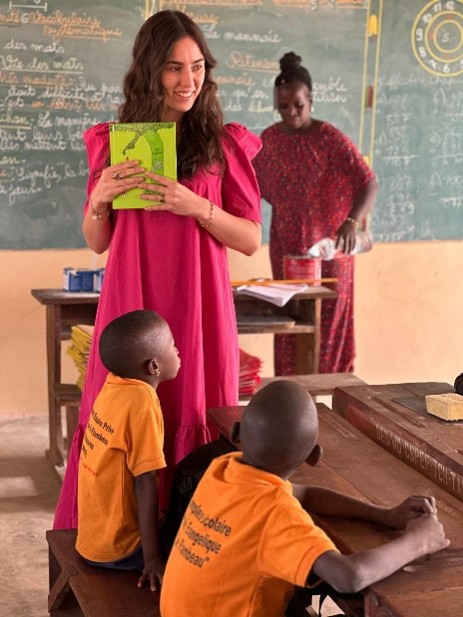
Fourth-year students from the primary teacher education programme at Driestar played an important role in the research. During their international placements in Benin and Nepal, they prepared a lesson about The Giving Tree together with local teachers. The students observed how the teachers explored the story with their pupils. Back in the Netherlands, several students taught the same lesson in their own placement classes.
In total, lessons from ten classes in the Netherlands, Benin and Nepal were included in the research. The aim was to discuss the story in a similar way across the three countries. Pupils were asked open-ended questions, with no single correct answer. Their own interpretations of the story were central.
In practice, however, the lessons unfolded in very different ways. In Nepal, teachers used drawings, objects and a puppet theatre, among other things, to bring the story to life. The children were enthusiastically involved, but the focus shifted away from the book itself and the discussion of its meaning. In Benin, the lesson followed the original instructions more closely, although the emphasis was sometimes primarily on expanding the pupils' French vocabulary. In the Dutch classes, the lessons largely followed the intended approach.
These differences provided valuable insights into how teachers understand their role and shape interactions with pupils. At the same time, it proved difficult to compare the lessons directly. Language barriers and differences in customary ways of communicating between teachers and pupils may also have played a part.
More than one right answer
One important finding was that children in all three countries sometimes found it difficult to answer open-ended questions. They had to get used to the idea that several answers could be valid and that their own interpretations mattered. Leading a meaningful classroom discussion proved to be a real skill, but when successful, it can be a valuable way of bringing people together.
The meanings children attached to the story were also revealing. Many pupils compared the tree to their parents or grandparents. In one Dutch classroom, a pupil compared the tree to God: “God is generous too!” When asked how this was shown, the pupil replied: “Yes, He gives us new hearts.” The pupil then reflected on whether God expected anything in return.
This conversation illustrates how a children's book can encourage pupils to reflect on themselves, their relationships and their faith. Reading therefore contributes not only to language development but can also play an important role in personal formation and citizenship education.
An unexpected interpretation from Benin
One of the most striking findings came from Benin. When pupils were asked who or what the tree might represent, some suggested that it symbolised the white people who had funded and built their school.
This interpretation surprised the researchers and prompted them to reflect. Although the story was intended to encourage connection and mutual understanding, these children also associated it with the relationship between benefactors and the local community. The cultural and social context of the reader clearly influenced the meaning they attributed to the story.
This insight also raises questions about how international cooperation is shaped. How can partners meet on the basis of equality and reciprocity? And how can we ensure that we do not focus solely on our own intentions, but genuinely listen to the experiences and interpretations of others?
Stories that connect
The research provided valuable learning experiences for both the local teachers and the Dutch student teachers. The teachers explored different ways of using a children's book interactively in the classroom. The students discovered how strongly cultural context, prior knowledge and personal circumstances can influence the way a story is read and understood.
Although the lessons did not always follow the intended approach and the results could not be fully compared, the book engaged children from a range of backgrounds. This highlights the potential of literature to spark conversations and bring people together.
The Literacy Research Group and Woord en Daad therefore hope to explore opportunities for more direct exchanges between teachers around the world in the future. After all, reading together is about more than understanding words: it also creates opportunities to get to know one another, discover different perspectives and grow in mutual understanding.