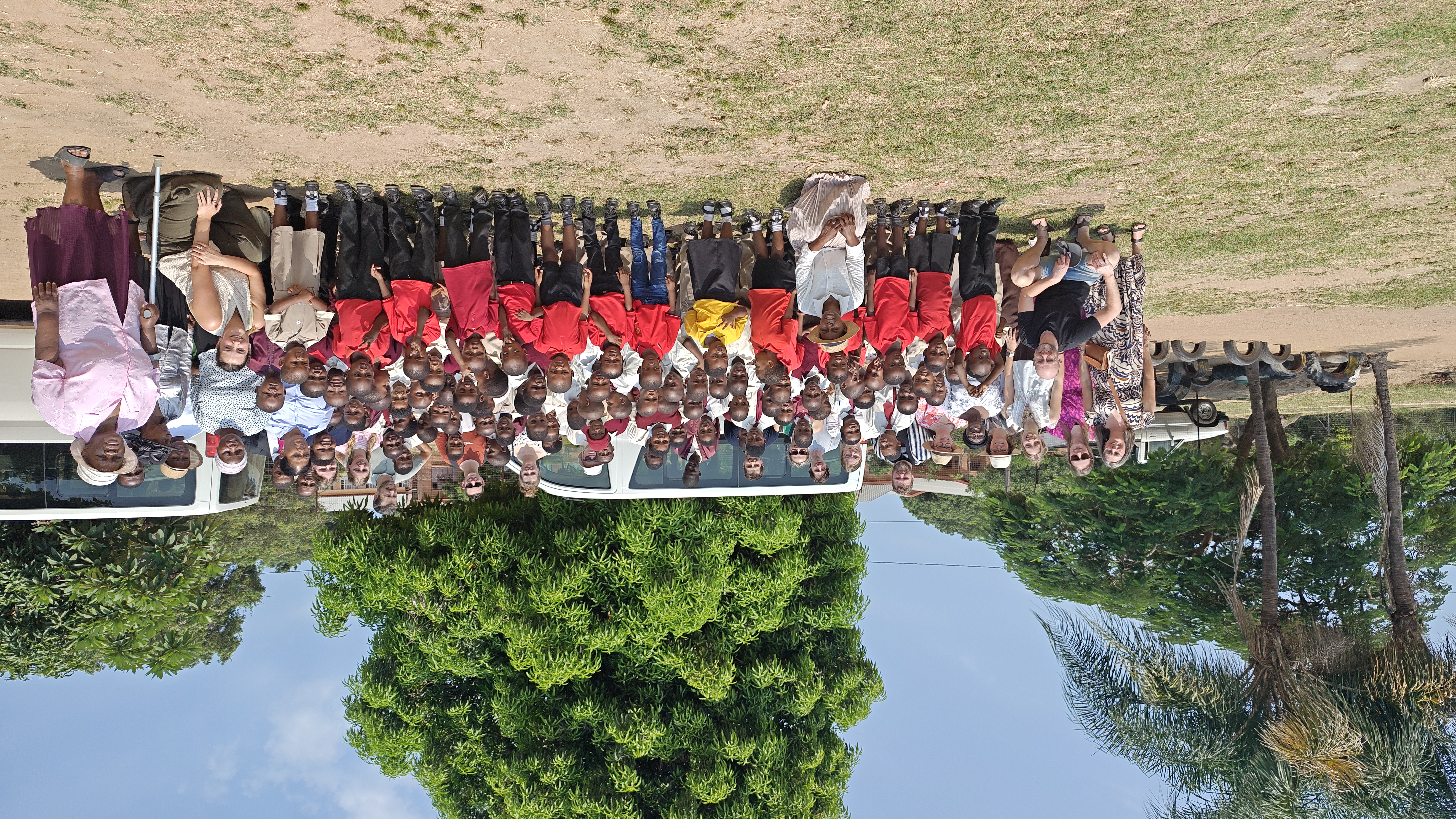
In the context of internationalization, a group of students gained intercultural experiences in South Africa. As teachers, Cornée Ferreira and Jasper Baaijens focused on the encounters we have as Christians with diverse cultures (including historical influences and perspectives), as well as on religious gatherings and education in ‘foreign’ contexts. The recurring question throughout the journey was: How do we and our values relate to each new context, and are we willing to suspend our judgments?
A powerful first confrontation was the prison complex for political prisoners on Robben Island near Cape Town. From around 1960 to 1991, many innocent people were imprisoned here. Leaders of anti-apartheid movements were isolated, while others were placed with up to 40 people in a bare room. Prisoners possessed only three blankets, two bowls, and a spoon. This was all shared with us by Monde, who had been arrested during demonstrations in Soweto for equal education for all races and spent 10 years imprisoned on the island. He pointed out his sleeping place on the floor—the same spot from 1977 to 1987. A deeply moving story. We also visited the cell where Nelson Mandela spent 18 of his 27 years in prison before his release in 1990. What stayed with us most was Monde’s call for communication and tolerance—coming from someone with such a history.
Later that week, we visited the place where Monde had once been arrested: Soweto (South Western Townships) in Johannesburg. Locals call it the heart of South Africa. For two hours, we engaged with the local community. We supported a kitchen where meals are prepared for children, exchanged high fives with enthusiastic kids, and learned greetings in isiZulu (“Unjani?” – How are you? and “Ngiyaphila” – I am well). Along the way, we enjoyed vetkoek, supported traditional dancers, and bought souvenirs and biltong from local vendors. We also tried a traditional lunch of pap with beef, chicken, and spinach. We look back on this experience with mixed feelings. The impact on the students was profound—talk about confronting other cultures.
Some of the children we saw in Soweto were also present at a poor secondary school we visited. After the abolition of apartheid in 1994, this school gradually shifted from entirely white to entirely black. It is a public school with classes of around 50 students. Only the top 20 percent receive significant attention. Few teachers are Christian, and in one economics class, a teacher passionately defended BRICS countries while denying the existence of God. Fortunately, we also visited an English lesson taught by an enthusiastic Christian teacher. He discussed a sonnet by William Wordsworth, in which Wordsworth calls upon the long-deceased poet Milton because he feels the moral state of his time has declined. The teacher asked students whether there are also things in South Africa to complain about today. Is the euphoria of 1994 still present? The students responded with concerns about corruption, broken infrastructure, and unemployment. Perhaps, they suggested, they should call upon Mandela in today’s context of moral decline. This teacher made the poem highly relevant and accessible, expressing strong belief in his students and their role as the future of the country.
The contrasts we encountered were striking. Alongside this township school, we also visited a wealthy, predominantly white school. We were invited to a gathering in the auditorium, where a student orchestra accompanied hymns. We were warmly welcomed—even in Dutch—and then given a tour of impressive facilities: a hockey field, music auditorium, swimming pool, gym, athletics track, tennis courts, and even their own water purification and power systems. What stood out most were the students’ manners. They addressed teachers with “madam” or “sir,” stood beside their desks until permitted to sit, and behaved respectfully and calmly. Compared to the average classroom in the Netherlands—a dream 😉!
We also visited a Christian school with students from mixed backgrounds, where racial divisions seemed temporarily invisible. The classrooms were calm, orderly, and disciplined, and the school clearly embodied its identity. Discipleship was visible in practice. After an introduction by four senior students, our group spread out across lessons in Afrikaans, Mathematics, English, Religion, and Accounting. During breaks, there were meaningful conversations with teachers about their views and practices. The most common response afterward was: “I would love to teach here!”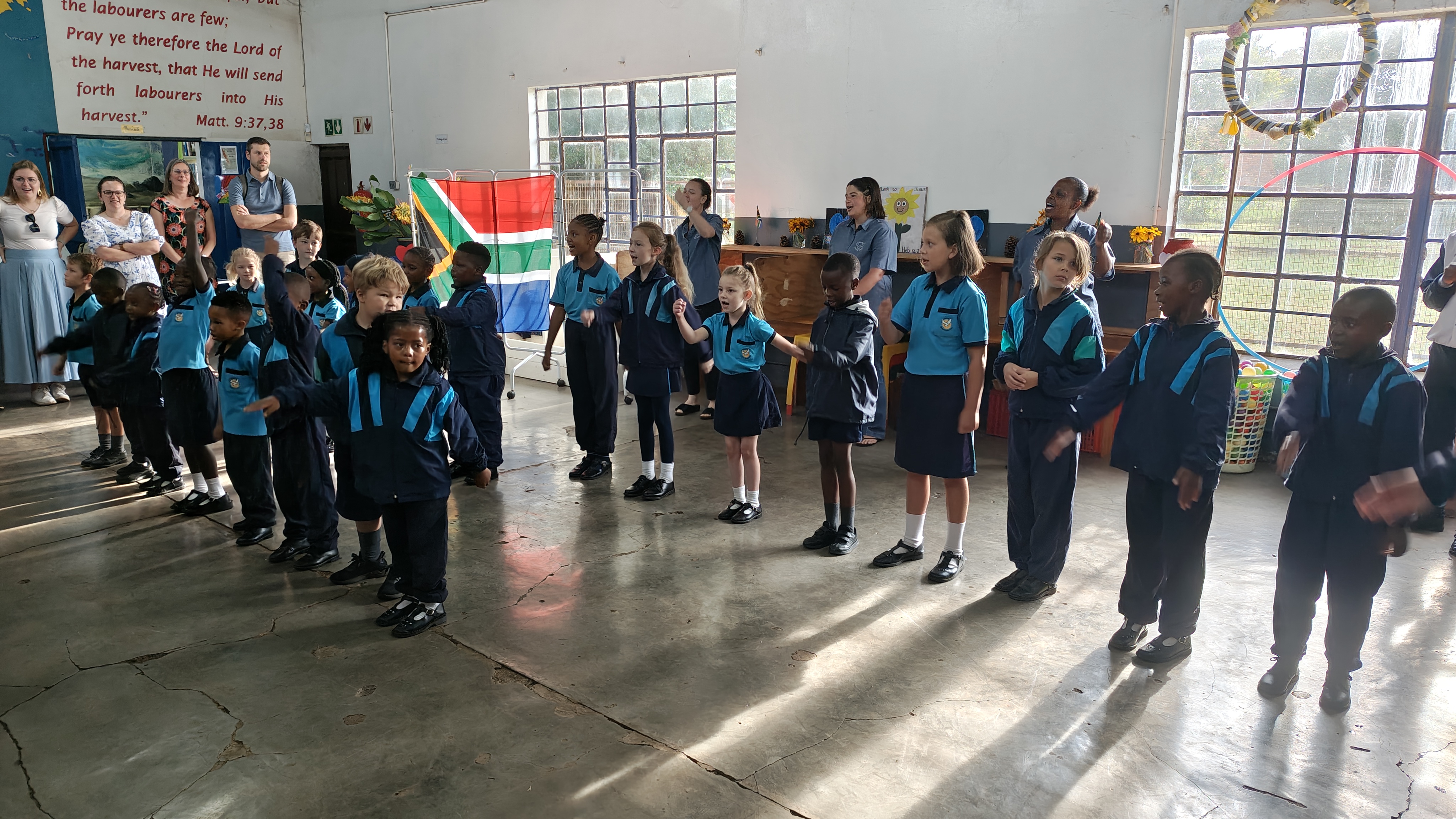
As every year, we also visited the very poor private Shalom Christian School. Here too, discipline was evident. Students stood neatly in rows, silent, waiting for teacher Joshua’s instructions. He led a reading, asked questions, and the group recited a pledge of loyalty to God, country, and school. The school follows the ACE (Accelerated Christian Education) model, where all materials—even for subjects like math and geography—are rooted in the Bible and the character of Jesus. Students work at their own pace, progressing to the next grade upon completion.
Unfortunately, the situation at this school is critical. The rented building is deteriorating, and inspections show that a new facility is urgently needed. The foundation www.fundisa4future.nl, led by Cornée and Jasper, aims to support this school and also Come Together Christian School.
The latter was the final school we visited, and nothing could have prepared us for what we encountered. The situation was heartbreaking: two dilapidated buildings and makeshift toilets—just holes in the ground. We were welcomed by Jabu, the daughter-in-law of Abigail, who founded the school. The staff consists of eight teachers, but salaries of 3000 rand are rarely paid; even 2000 rand (about €100) per month is often unattainable. Abigail shared her story in broken English. She attended school for only 18 months due to illness (suspected leprosy). She described how she once hated her own people, who excluded her and took her belongings, while white nurses showed her kindness. Eventually, her hatred turned into compassion. She began preaching the gospel and founded an orphanage, now part of the school. Her mission is clear: to share the gospel and provide opportunities she herself never had.
The conditions are extremely harsh. Classrooms are unbearably hot under corrugated metal roofs. Electrical wires hang from the ceiling. During the rainy season, water floods the rooms, soaking books. Materials are secondhand donations from a school in Nelspruit, with previous answers erased so students can reuse them. It is deeply distressing. Yet the teachers show immense patience and dedication—despite their minimal income. Jabu showed us building plans from 2006 for a new school. There is no funding—but they pray, trusting that God will provide.
This journey offered a powerful series of intercultural encounters, where compassion, wonder, frustration, unity, shock, and gratitude continuously alternated.